
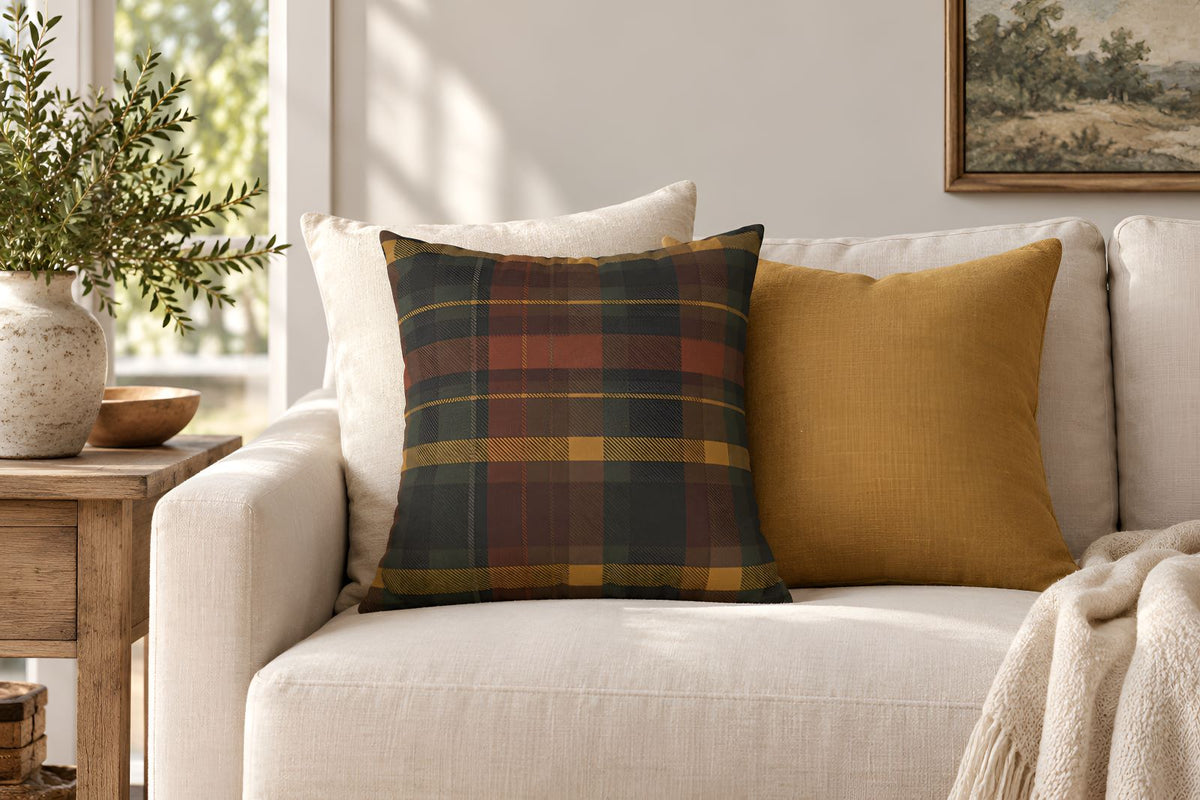
One patterned pillow can give you the starting point for an entire sofa. If you’re wondering how to mix and match throw pillows without making the room feel busy, begin with the colors already in the pattern. Choose one shade to repeat in a solid pillow, leave some neutral space around it, and build from there.
Let the plaid choose your starting palette
Look closely at the pillow before choosing anything to go beside it. Notice the broad checks, the background shades and the thinner stripes running through them. You don’t have to repeat the most prominent color. A narrow stripe can offer a useful connection to another piece.
Our Cabin Check pillow cover combines deep green, charcoal, rust, brown and muted gold. Those earthy shades offer several directions for a nature-inspired living room, from a light sofa with warm accents to a reading corner with wood furniture and deeper greens.
Choose the direction that works with the room you already have. You don’t need to bring every color in the plaid into the rest of the space.
Pull a quieter stripe into a solid pillow
A smaller detail in a pattern can become the link between your pillows. With Cabin Check, try drawing out the muted-gold stripe in a plain ochre pillow. The repeated color connects the two, while the solid fabric leaves the plaid as the main pattern.
Keep that supporting gold earthy and subdued. A bright yellow would create a different effect, even though both might be described as gold.
Remember that a color appearing in a thin stripe will become much more noticeable across a whole solid pillow. Start with one supporting piece and look at the arrangement from across the room before adding more of that shade.
Try green and ivory for a quieter combination
If you prefer less emphasis on gold, choose a solid green that relates to Cabin Check’s darker checks. Add warm ivory through another pillow or a simple throw to keep the seating area from becoming too dark.
This combination lets the green connect the pieces while the ivory separates the deeper colors. It is a useful starting point for a light sofa, especially when you want the plaid to remain the most noticeable detail.

Add texture before adding another pattern
Once the colors feel right, consider the surfaces beside them. A plain knit throw, a softly textured solid pillow or the grain of a nearby wooden table can add interest without introducing another set of stripes or checks.
You can start with what you own. Place the plaid beside a solid pillow, then try a different throw. Changing one piece at a time makes it easier to see which combination you prefer.
If you do want another pattern, look for a different scale and a shared color. You can also stop with plaid and solids; a second print is optional.
Arrange the pillows so the plaid stays visible
On a sofa, try placing a solid pillow behind Cabin Check with enough of each showing to make the color connection clear. If you add a third pillow, keep the overlap light enough that the plaid can still be seen.
Stand back and check the whole seating area. Can you see the pattern? Does the supporting color connect to it? Is there enough clear seat space to sit comfortably? Remove a piece if the arrangement feels crowded.
Nearby rugs, curtains and upholstery count as patterns too. If those already carry plenty of detail, a simpler pillow combination may be all the room needs.
Start your arrangement with Cabin Check
Cabin Check’s earthy tartan gives you several colors to work with in one square pillow. Pair it with muted gold for a warmer accent, or draw out the green and add ivory for a quieter arrangement.
The cover is made from soft spun polyester and comes in 18-inch and 20-inch square sizes. Choose the size and cover or filled-pillow option that suits your space on the product page.
Explore the Cabin Check pillow cover and options, or browse Durazza’s pillows and pillow covers for other starting points.
Need help getting a fuller finish? Read how to fit a 20-inch pillow insert into an 18-inch cover.